Category: Aesthetics and Philosophy

  • beatrice and virgil

    beatrice and virgil

    I found Beatrice and Virgil at Grounds for Thought in Bowling Green Ohio, over to the left of my tiny table perch while waiting to get my car inspected. This coffee shop has a wraparound floor plan and the secret back area is usually dead silent with a nice musty bookstore odor to accompany your glass-mug caffeine of choice. The floors are well worn, as are the electrical outlets, and the panoply of books and ephemera renders as intriguing than overstimulating somehow.

    I look left and scan, noting known titles or popularities, or thinking up which “M’s” I know in my reading backlog and I spot Yann Martel’s books, and a cute hardback called Beatrice and Virgil with an appealing jacket and thick clean pages. I start reading.

    It feels serendipitous: a returning to my essays on Life of Pi while young in college, and a reminder of happy naïve reading that for all of my twenties I abjured for intense philosophical study (which, philosophy for a twenty-something is a fine way to avoid one’s actual life problems… more on that elsewhere). Something like joy welled up in me.

    Another serendipity looms, or more a synchronicity in Jungian fashion, where the topic of Henry’s book is the holocaust. Meanwhile, I’ve been watching The Man in the High Castle, a historical fiction just of the sort Henry is trying to get us to either make, or expand beyond in terms of fiction (I will find out). Sometimes when these “topics” congeal in my life it feels more than accidental.

    Serendipity landed harder when the back cover mentioned “who we are and what we are capable of doing in order to survive”– which I read in the wake of finding out I needed $2300 in repairs on my car in the midst of a move and the weeks-long delay of my summer job starting with fall school fees looming. Still, I think these are pedestrian problems in light of people I know and people who I imagine exist. I can make it. Struggle makes me feel alive, said Alysa Liu.

    I like to take these serendipities and run with them, because generally my question of “what to do next” has to be answered by a throughline where I grow my network of experience into a “pocket” of inquiry: Oh this part over here I connected to these other texts, which have such and such philosophical import overall etc. As Henry says: “stories…are what stitch together the disparate elements of human existence into a coherent whole.”

    To pursue a throughline in our thinking is sort of banal, but it’s also existential: how do we choose what to do? Why pursue THAT? We either chase after things with rational justifications, or let the waters of life guide us. We vary in our authenticity when approaching the question.

    This throughline is important compared to what algorithms give us. We have ANY sort of content thrown at us. There’s a haphazardness to it, and what Kierkegaard or Dreyfus would call a “leveling” of importance. Everything is treated as equally valuable.**

    “What Kierkegaard envisaged as a consequence of the Press’s indiscriminate coverage and dissemination is now fully realized on the World Wide Web. All meaningful differences are, indeed, leveled. Relevance and significance have disappeared. And this is an important part of the attraction of the web. Nothing is too trivial to be included.”1

    In contrast, I say to the serendipitous, only certain things are valuable, and they are related to what we already are in some fashion. That might sound like a contradiction: serendipity and what you already are. But for something to feel like serendipity it has to feel coherent.  It “breaks in” somehow because it is relevant, and what is relevant is funded by a significant backlog of experience. It also contains its own numinous quality of being beyond randomness.

    Anyways, the ensuing exposition reads much like Zen and the Art of Motorcycle Maintenance: A pseudonymous author self-narrates their philosophical aims and misunderstandings from the institutional guardians. It’s a sort of procedural, a story outside of the story before the story proper begins. But it’s also in the space of something working to be philosophical while being eminently readable, and itself indicates how fiction and the “low brow” can be deeply important:

    “Fiction and nonfiction are not so easily divided. Fiction may not be real, but it’s true.”

    I am here in my present struggle, the book is tending to significance based on my personal history, and it’s been years since I let reading just be about simple truth in light of what I’m experiencing. Maybe it’s time to love what I read again.


    **

    **I think there’s a nice discussion to have there: we encounter randomness in life, don’t we? And the algorithm feeds us curated content, so it’s not “random.” But clearly unimportant, or trolling, or absurd or etc. content is rampant and it inverses what is “valuable” to humans in gaming the algorithm.

    I think few would say they encounter numinous serendipity online, as I will discuss shortly.

    1

    Wrathall, Mark A. (ed.), ‘Nihilism on the Information Highway: Anonymity versus Commitment in the Present Age (2004)’, in Mark A. Wrathall (ed.), Nihilism and the Technological Age, in Mark A. Wrathall (ed.), Background Practices: Essays on the Understanding of Being (Oxford, 2017; online edn, Oxford Academic, 20 July 2017),  https://doi.org/10.1093/oso/9780198796220.003.0012, accessed 29 June 2026.
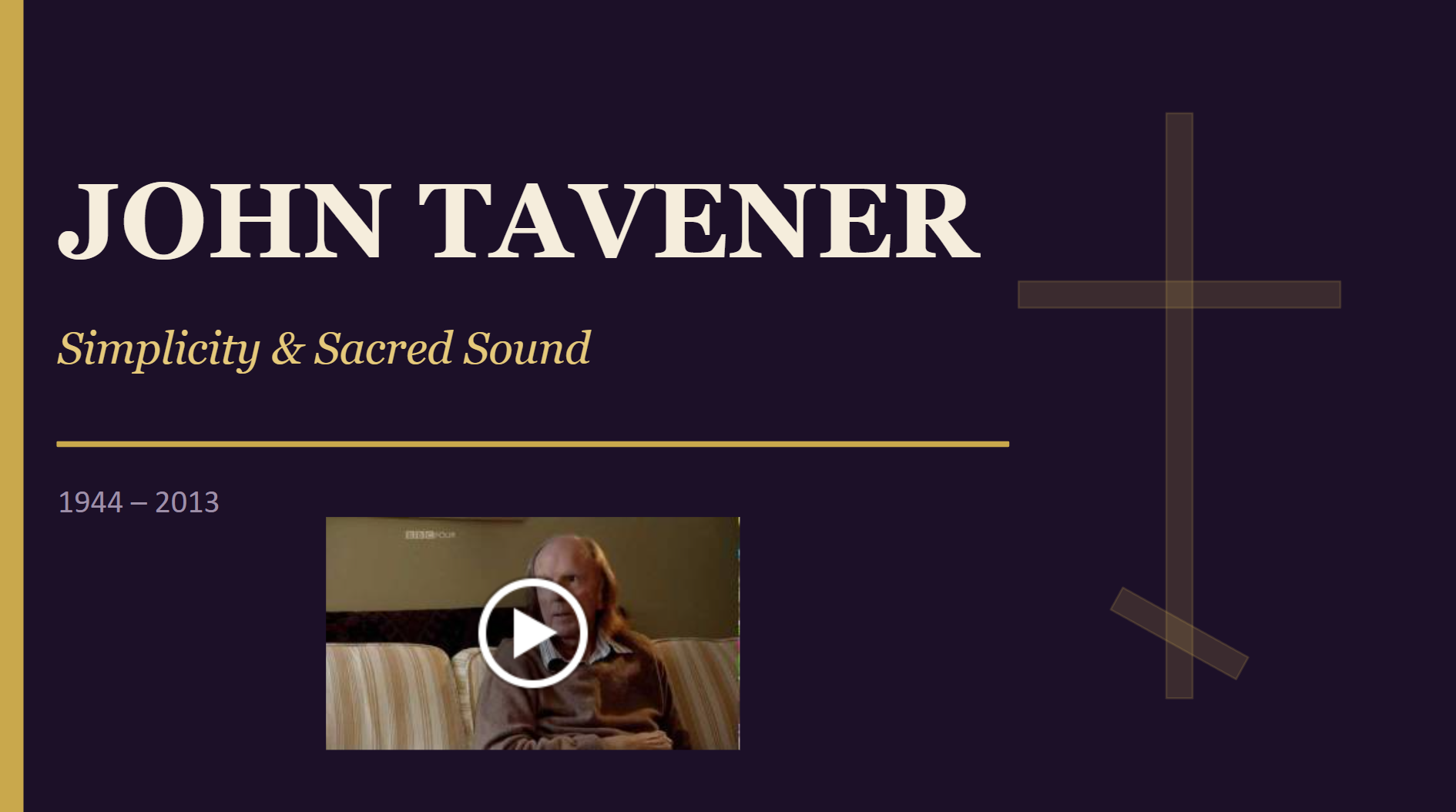
  • john tavener presentation

    john tavener presentation

    another short presentation given in spring ’26 at BGSU

  • piano phase presentation

    piano phase presentation

    Gave a brief presentation at BGSU in Spring ’26 on Piano Phase! My main thrust was that phase music will make the perceptual states discussed in gestalt therapy very clear: figure/ground formation, how the organism searches for interest to meet its needs etc.

    Slides below!

  • chaya czernowin

    chaya czernowin

    Handout from a Spring ’26 presentation at BGSU.

  • What Makes Music Good? Susanne Langer’s Discursive and Presentational Forms Explained

    What Makes Music Good? Susanne Langer’s Discursive and Presentational Forms Explained

    “I’ve made a big mistake.”

    My best friend and I are preparing to present at a conference and I realized it’s actually insane what we’re going to try and accomplish, and it could be a total trap that makes us look like fools. We’re presenting on quality wind band music. Which means if we don’t pick good pieces, we’ll look dumb. But also, I’m going up there and claiming to understand the philosophical ground that makes up good music, which is an atom bomb of a prerequisite.

    It means I have to define the field of aesthetics AND have the taste to know a criteria-meeter when I hear it. And so I realized I accidentally waltzed into one of the biggest philosophical trenches I could’ve picked, all while not having much experience with aesthetics per se.

    My definition of good music:

    After a period of reflection I have decided how I’m going to characterize this perennial issue of what makes good music good. It’s not anything high-brow, but I think it’s enough to teach an important principle to both laypeople and composers of music.

    My principle for goodness is this: “the music rewards multiple listens and continues to reveal itself.”


    Are you still here? Love to learn and discuss? Join my list and let’s bring back serious thinking:


    Nice versus good:

    The opposite of this is “candy music” or music that goes down in one pass, like a Disney song: something so overtly accessible that you are challenged in absolutely no way. That is called nice music, but it is not good music because your expectations are rarely challenged.

    Our programs can have NICE music. But I’m going to reserve the term GOOD music for something that aspires to guiding us toward the strange possibilities of cognition in response to sound, if not toward sublimity.

    And I’m thinking of this in a balanced way. Things that “push the limit” can aspire to goodness, but by lacking balance they fail to activate the mind/heart in a humane way. I’m thinking of music that mostly makes us respond in a thinking manner with very little sensory or feeling engagement. Thinking is not wholly cognition and the heart is not only feeling etc. ***

    ***Stuff about Jung in here

    (Jung’s functions are a fabulous thing to apply to musical response. For example, we can ascertain an overall picture of a piece using nonlinear intuition. Feeling and thought are not diametrically opposed, and are actually two rational functions etc. Hugely important for describing aesthetic response).

    I realize I’m avoiding the question of what is “bad” music here, because I’m not going on stage and saying “this composer wrote bad music.” because I’ve just started composing professionally, and I don’t have a lot of good music, or even nice music!

    Further, I think the question of nice to good is more interesting than what is bad, because it helps us distinguish between pieces that are fine, and pieces that elevate us aesthetically. In this terrain we learn something about our cognition in response to stimuli.

    —

    The Aesthetic Response: Cognitive Formations

    Let me talk about how music can ignite the play of cognitive formations, because this is an important part of a good piece.

    Use the art comparison: When you look at a Kandinsky, it does stuff to you. Formations appear in your mind, associations appear, things bounce off of one another. It might even introduce a sensation ranging from a blissful glow to a curious delight.

    I’m not the only one concerned with these “formations” I speak of. Langer wrote about music being an unconsummated symbol of human activity and thought in her book Philosophy In a New Key:

    https://www.themarginalian.org/2017/05/24/susanne-langer-music/

    Some music can aspire to these heights of aesthetically representing the nature or quality of thought/activity itself.

    But Langer went further and said music is an unconsummated symbol, meaning it is only fully activated once we relate the parts of the music to other parts of it. After apprehending it we can start to understand it. And thus we have an inroad to my thesis that good music must reward multiple listens, because to comprehend music at all, or at the level of a symbol of any significance will require multiple listens at the outset.

    https://www.themarginalian.org/2017/05/24/susanne-langer-music/

    I’m going to introduce a big caveat or qualifier here.***

    ***The big caveat or qualifier***

    ***What do we make of a piece that we literally only hear once? What about jazz? Isn’t jazz good music when we hear it once at a club?

    So clearly other features of musical interest can let us interrogate the good music question, but for today my adumbration is just on the fact of some music being interesting over time.

    Or we could say.. WOULD this music I heard just once reward multiple listens? And that could bypass the issue I’ve raised.

    If you wanted you could bring up a whole scheme about my discussion privileging European music and the centering of whiteness or something. Go for it!***

    Here is an intro to Langer’s forms:

    The discursive form of a piece is how it shows up to us when we first hear it. We relate nearby materials to nearby materials and it discloses something cogent to us.

    The presentation form of a piece is how it shows up to us when we regard it as a whole. In this form we can pick at it and think about it.

    So I want to use this terminology as a means for cataloguing “good” music in terms of listening over time.

    Aesthetic responses as they relate to forms of temporality:

    Can a piece withstand further listens after we’ve conceived of the presentational form? If something goes down immediately in the discursive form, there’s a good chance it won’t last in the presentational form. A good piece is dynamically updated, not lessened, once we determine the presentational form.

    (here I am assuming ascertaining the presentational form is a sort of cognitive act, not entirely a listening one).

    I find it unacceptable to think that ONLY our very first listen of a piece is the discursive listening moment. That seems too flippant and marginalizes listening to live music. I think repeated listenings are still discursive, because we haven’t built the mental structure to hold the whole piece in mind yet.

    So I don’t think the forms are two kinds of listening. They are relations of cognition…There is plenty more thinking I can do here.

    Somewhere in this economy of hearing a piece, being challenged by it, and aggregating a presentational form about it that informs our discursive listening, is what I’m offering as a framework for what a good piece is doing when we both enjoy it and can think about it for extended periods of time. It rewards long-term listening, and repeatedly reveals more of itself to us through our forms of cognition.

    What is a masterwork?

    Going beyond this, we have those works we find we can do extended thinking about and be impressed by intricacies contained within and find delight in those. I presume these are the kinds of works we canonize and pass down through history. Perhaps this is the territory of the masterwork, because further time and delineation allow the piece to CONTINUE to be revealed to us beyond the time we listen, conceive of our listening, and listen again. Its formulations make it an edifice unto itself and a body of theory will accrue around it.

    In sum:

    There we go: my formal definition of music that is nice, good, or a masterwork. Note that the term good is not merely “good.” I am conceiving of good as something that produces aesthetic delight, interest, sublimity, and enriches our conception of what cognitive formations are and what being minded means.

    And my best clue for a “good” work that makes being human what it is? How many times you can listen to it and still find interest.

    Thanks for reading.

    I started making a course based on the content of this blog post, check it out for free:

    (note the forms below will say “incorrect” at this stage. If you want me to personally read your responses, use this Google Form).

  • foam hammers

    foam hammers

    How is that academics practicing in a hermeneutic milieu also find themselves passing judgment on historical figures for things we currently find immoral? If hermeneutics has to do with “positioned” knowledge, then why this laundering of history? Why judge the past from the present?

    A similar problem: that these academics would probably say morals are a choice, and local. Yet they interrogate the past for problematics using a “universal” rubric, as though everyone in the past “should have known better.”

    Why do relativists insist on their views? Does their action foreclose the validity of what they say? How can a relativist try convince you they have the better view? Aren’t they beating you with foam hammers?